Cystic Fibrosis Frequently Asked Question
 |
The questions and answers are from our discussion board. If you do not find an answer to
your question here, try visiting the forums.
|
-
What is Cystic Fibrosis?
Cystic fibrosis (CF), also called mucoviscidosis, is an autosomal recessive hereditary disease that affects the lungs, sweat glands and the digestive system. Close
-
Is CF contagious?
No, CF is not contagious and is strictly genetic. Close
-
As a person with CF lives longer, is it inevitable that they will need a lung transplant in the future?
There are many individuals with CF that are passed the age of 30 that still have their original lungs. Having a lung transplant may not be inevitable, but it is dependent on how well you take care of your body and how well your body is coping with CF. Close
-
Who is Beth Sufian?
Beth Sufian is a partner of the law firm Sufian & Passamano in Houston. She was diagnosed with CF at the age of 9 and has dedicated herself to helping those in need. To learn more about Sufian and the Sufian & Passamano law firm visit www.sufianpassamano.com.
Their contact information is:
Sufian & Passamano, L.L.P.
811 Rusk Avenue, Suite 712
Houston, Texas 77002
Telephone: 713-224-1166
Facsimile: 713-224-1161
E-mail:
BethSufian@aol.com
JamesPassamano@aol.com
Close
-
What is SSI?
SSI stands for supplemental security income. It is a program that provides limited income assistance to those who are age 65 or older, disabled or blind. SSI is available to both children and adults if depending on their condition. SSI receives funding from the federal government and is administered through the SSA (Social Security Association). SSI is not the same as Social Security, because SS is a program that provides only retirement funds to those who have worked enough to qualify. Close
-
What is PFT and is it routine for those living with CF to have it done?
PFT stands for Pulmonary Function Test. It is used to measure a person's breathing behavior. There are many tests that are done during the PFT. The purpose of the PFT is to help your doctor determine the best type of treatment for you. It is common for a person with CF to have a PFT done at each clinic visit, which is usually every 3 months or sooner depending on the person’s condition. Close
-
Is it important for individuals with CF to exercise?
It is important for anyone, with or without CF, to exercise. Although it is highly recommended for individuals with CF to exercise regularly in order to strengthen their lungs. Close
-
What is the difference between Medicare and Medicaid?
Medicare is a federal health insurance program. It is federally funded and is administered to those who are elderly or disabled. Every legally employed individual contributes to Medicare during their working years.
Medicaid is a program that provides medical aid to those of all ages who have low income and do not have the means of paying for medical expenses. The program is run by both the federal and the state governments. Eligibility is based on income and medical necessity. Close
-
What is Medicare part D?
Beginning January 1, 2006, Medicare will be contracting with private companies to offer the benefits of Medicare part D. Individuals will be able to purchase this coverage through these contracted plans.
For more information about Medicare part D, visit http://www.healthysolutions.anthem.com/NE-CTMED/content.cfm?ID=654 Close
-
What is Colonic Irrigation?
Colonic Irrigation is an internal bath that is used to cleanse the colon of gas, poisons, and fecal matter. It is a steady in and out flow of cleansing in colon. The process is approximately 30 minutes long and is administered by a practitioner. Close
-
What is Hypertonic Saline?
Hypertonic Saline is similar and as safe as ocean water. It thins thick & sticky secretions, washes out frustrating particles that effects the nose which will produce mucus, swelling, sneezing & itching, and shrinks swollen membranes by osmosis. It is used to reduce the need for antihistamines & antibiotics. It also improves the symptoms of nasal & sinus diseases. Close
-
Is over sensitive nipples directly related to CF?
Over sensitive nipples or "painful nipples" is not directly related to CF. In the case with women, it could be early signs of pregnancy, hormonal changes, or a reaction to medication. For men, it could also be do to hormonal changes or a reaction to medication. Close
-
What is a Nebulizer?
A Nebulizer is a mechanism that is used to turn a liquid medication into a mist for easy inhalation. The liquid is turned into mist with the use of pressurized air generated by the nebulizer. CF contributes the vulnerability of constant lung infections. A nebulizer may be hand-held or larger ones that require a mask to be strapped around the face. Close
-
Can men with the CF illness still produce children?
All men with CF may produce children, but natural production is depending. If a CF man is diagnosed with CBAVD his sperm will not be able to reach the ejaculatory duct. In this case, a man still has the option of IVF (In Vitro Fertilization). Unlike artificial insemination, where the sperm is placed in the uterus of the female, IVF is combining eggs and sperm outside of the body and inside a controlled laboratory facility. Sperm production continues, but it is the method of release that is the problem. Close
-
What is IVF?
IVF stands for In Vitro Fertilization. This is where eggs from a woman’s ovary is collected and then combined with seminal fluid. If the sperm from the seminal fluid fertilizes the egg(s), then the resulting embryo(s) is placed into the woman’s womb. Close
-
Is coughing up blood common among individuals with CF?
Coughing up blood is referred to as Hemoptysis. A small case of it is common amongst CF patients. If it happens too often please contact your doctor. Close
-
Is it common for CF patients to feel cold all the time?
Being cold is not a common effect of having CF, but the symptoms do vary from patient to patient. Close
-
Should a person with CF have a pet that may shed, such as a dog or cat?
There are many CF patients that do have pets and are encouraged by their doctors to have them. Dogs or cats should not pose a really big issue in regards to a CF patient’s health, unless they are naturally allergic to these animals. Close
-
Are there any programs for CF patients that can help with housing?
There are not many programs that are designed for aiding CF patients with housing. The best thing to do is to contact your state for more information. There are, however, many organizations that will try to aid CF patients by covering their medical expenses. Refer to the first question to view those organizations. Close
-
My doctor requested a CBC test done. What is CBC?
CBC is an abbreviation for Complete Blood Count; also known as FBC (Full Blood Count); also known as Hemogram. This is a test that will determine information on the patient’s blood cells. Close
-
Does the results of a sweat test have anything to do with the severity of your lung disease?
Sweat test levels are not determined by the severity of the lung disease and are used for diagnostic reasons. Results over 60 indicate CF, 40-60 is border-line, and below 40 indicates no CF. Close
-
I have CF with diabetes. It is difficult to eat enough calories needed to restrict my continuing weight-loss and steady the level of my blood sugar from going up. What can I do to avoid all this?
A CF patient must count their calories to make sure they are not decreasing and make sure they stay above the normal calorie intake for an individual living without CF. Find a doctor who is familiar with the kind of diet a CF patient with diabetes needs. If you are insulin dependant a dietician will want you to count carbs so that you can eat what you want and just adjust your insulin to meet your carb intake. Some diabetes patients have an insulin pump, which will allow them to eat anything they feel like while giving themselves insulin to cover the carbs. Close
-
What are the symptoms of CFRD?
CFRD stands for Cystic Fibrosis Related Diabetes. Here are some of the symptoms of CFRD:
People with CF, suffer frequent infections. This may have an impact on insulin resistance (how the body responds to insulin)
A high energy intake is needed to combat recurrent infections and lung disease.
Poor appetite and other factors such as impaired function of the pancreas and poor absorption of food, may lead to malnutrition. This may occur due to the pancreas not producing chemicals (enzymes) which pass into the gut as food leaves the stomach. About 85% of patients with CF have pancreatic dysfunction.
This information was found at www.diabetesuffolk.com/Complications/Cystic%20fibrosis.asp#_Toc56911070 Close
-
What is expected in a sweat test?
The sweat tests are not hurtful or invasive. Different centers have various methods for producing sweat. Some will have the patient wear more than enough clothing and have them run around. Other centers will use a device that is attached to the skin which will stimulate the sweat glands. Close
-
What are some CF related charities?
www.milanfoundation.org
www.esiason.org
www.inciid.org/article.php?cat=news&id=386
www.cff.org Close
-
What is 65 Roses?
65 roses is what some children with CF call the disease. The pronunciation between Cystic Fibrosis and 65 roses is very similar. Close
-
Where can I find information for children?
-
I'm looking for a support group, where can I find one?
If you're looking for support the best place to start is our forums. With over 40,000 messages and nearly 2,000 users its a great place to find support, answers and much more. Close
-
Where can I find an association near me?
-
I need to find a CF Center close to me, where can I find it?
Our CF Centers page has a comprehensive list of centers around the country. Close
-
What is TOBI?
-
Where can I find information regarding the Delta F508 mutation?
-
Are there any pictures of people with Cystic Fibrosis?
-
Is there are forum / discussion board I can visit to interact with others?
CysticFibrosis.com has one of the most active CF forums on the internet. Click here to visit. Close
-
Where can I find information regarding FEV1?
-
I'd like to purchase a CF bracelet, where can I do so?
The Cystic Fibrosis Foundation (CFF) sells bracelets here. Close
-
I'm looking for articles, where can I find them?
-
What is Creon?
Creon is an enzyme that helps digest foods. Close
-
Is there a live chat where I can speak with someone?
Our forums have a built in chat room that can be used by anyone. In order to use this feature you must be a registered member of the forums, to register click here. Registration is completely free. Close
-
What is Pulmozyme?
Pulmozyme is a medication that helps manage the symptoms of the genetic disease cystic fibrosis. It is a man-made form of a naturally occurring substance called DNase that is produced by the body in small amounts. Pulmozyme is inhaled into the lungs using a nebulizer and a compressor. Close
-
What are Pseudomonas?
Pseudomonas aeruginosa is a versatile Gram-negative bacterium that grows in soil, marshes, and coastal marine habitats, as well as on plant and animal tissues. People with cystic fibrosis are particularly at risk of disease resulting from P. aeruginosa infection. Close
-
What is MRSA?
MRSA is short for Methicillin-Resistant Staphyloccus aureus. Methicillin was an antibiotic used to treat S. aureus in the early 1960s before it was replaced by less toxic 'cousins' such as flucloxacillin. MRSA is resistant to flucloxacillin, the most commonly used antibiotic for anti-staphylococcal prophylaxis and treatment of patients with cystic fibrosis (CF) Close
-
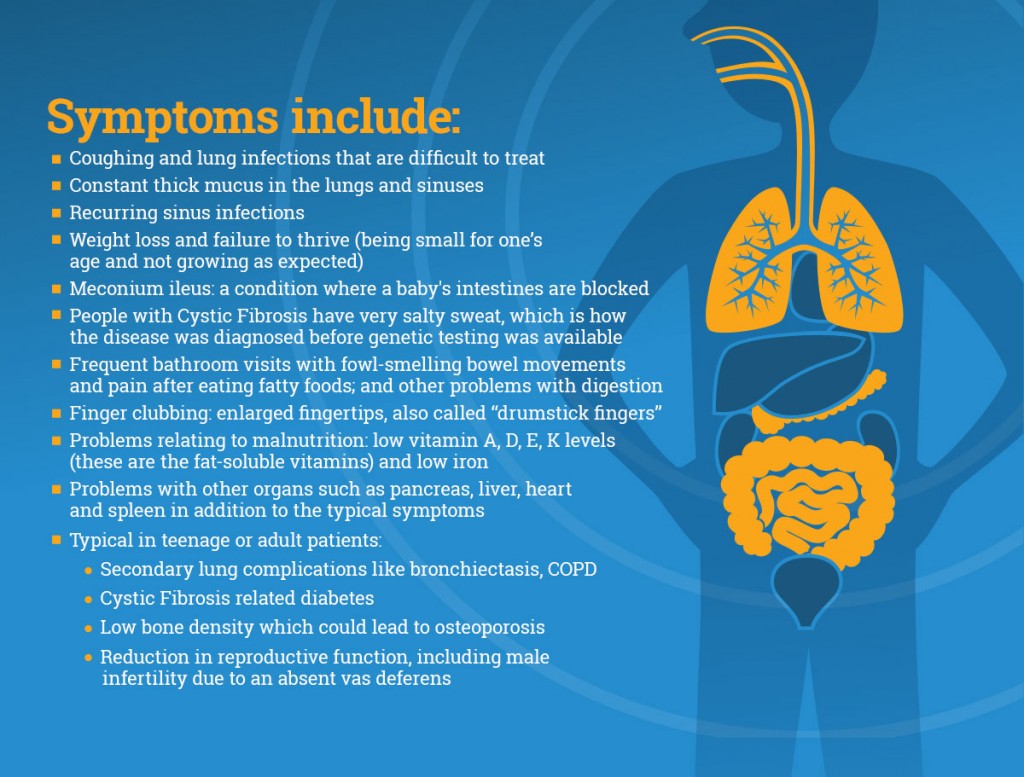
Why do some people with Cystic Fibrosis have clubbed fingers?
Clubbed fingers is a symptom of Cystic Fibrosis which comes from malabsorption. Close
-
How can I make a donation?
The Cystic Fibrosis Foundation has many ways that you can make a donation, click here for more information. Close
-
How many people have Cystic Fibrosis?
There are approximately 30,000 people who have Cystic Fibrosis in the United States. Close
-
I am a spouse of someone with Cystic Fibrosis, are there other spouses I can speak with?
You're not alone, many spouses come to the site looking for information and support. A great place to speak with other spouses is on our forums. Close
-
Where can I find out more information regarding Cystic Fibrosis?
We've just recently opened our wiki which has a great amount of information. The wiki is maintained and updated by the community. Close
-
What is an exacerbation?
Basically it is a flare up where things go haywire &/or an infection kicks in Close
-
How can I find out about clinical research for CF in my area?
CF Foundation-accredited care centers are excellent sources of information about current clinical trials. The care centers have access to CF foundation sponsored clinical trials in their area. You can go to www.cff.org and check out the Research and Clinical Trials section to find out about studies. Also visit the National Institute of Health Site that lists other clinical trials, http://clinicaltrials.gov Close
-
What’s the difference between FEV & FVC- do improved scores always mean a study drug is working?
The FVC (Forced Vital Capacity) measures the total amount of air that can be moved voluntarily in and out of the lungs with no time constraints. The FEV (Forced Expiratory Volume) is a volume that is moved out of the lungs in a specified period of time, usually one second. In interpreting changes in these values, one has to be careful that the changes which are large than the normal variation in pulmonary function testes are from chance versus general improvement in the test that may be related to a study drug. Close
-
What website lists all the known CF mutations?
The website listing the current know CF gene is http://www.genet.sickkids.on.ca.cftr/ Close
-
Where can I find assistance paying for CF medications?
For a list of patient assistance programs by manufacturers of CF products, visit CF services at www.cfservicespharmacy.com. Visit the CF Foundation’s website, www.cff.org for information on insurance and a list of state programs. Close
-
Is there any pending legislation to help raise CF awareness?
Every year, the CF foundation works with the US Senate and the National CF awareness committee, http://www.cfawareness.org, to introduce new legislation to declare may as CF Awareness Month which coincides with the CF Foundations GREAT STRIDES national walk-a-thon to raise funds for CF research. Please go to the CF Foundation’s website, www.cff.org for more information. Close
-
Is there a special test to determine if a baby (unborn) has CF? How early in a pregnancy can it be determined that a baby has CF?
There are two tests that can find out if an unborn baby has CF. The first is called chorionic villus sampling (CVS). This is where a small piece of placenta is taken and tested early in pregnancy. The second is called amniocentesis and it testes a small amount of the fluid around the baby in the uterus. Talk with an obstetrician to find out when during pregnancy these tests can be performed and what the risks are for either of these tests. Close
-
Are there different levels/severities of CF?
CF can affect people differently. There are more than 1,300 mutations-or versions- of the defective CF gene. These mutations impact people differently. Some people have more severe lung disease at an early age, and others have more problems with their digestive system. Scientists are studying gene modifiers to find out what may affect the CF gene and the severity of the disease. Close
-
What is the longest a person has lived with CF?
The oldest person with CF was 76 years of age Close
-
What is a CF blood/mutation test?
Blood is drawn from your arm and sent to a laboratory. There, a technology called PCA (polymerase chain reaction) is used to screen your DNA (the genetic material within your cells) for the most common mutations that cause CF (Genzyme tests for 97 mutations; http://www.genzymegenetics.com/about/news/gene_p_news_CFplus.asp , Ambry genetics tests for 1,300 known mutations http://www.ambrygen.com/ts/ts_cf.htm , and Quest Diagnostics tests for 99% of all known CF mutations http://www.questdiagnostics.com/hcp/topics/cf/cf.html ) Close
-
What is a Mickey Tube
A gastrostomy tube that is held in place by a balloon inflated with saline. A MicKey tube is a "balloon" type. A MicKey is much easier to replace. You can change it at home on your own, which is actually not as daunting a task as it sounds. It can be very convenient when you accidentally pop the tube out at 3 AM. This is also helpful if your GI doctor is far from home.
In addition, you may have an actual tube that protrudes from the body (a Gtube) or a gastrostomy button which lies flat, or mostly flat (again, depending on the manufacturer) on the stomach. When using the button, you attach a feeding tube to the button and remove it when you are done feeding the child. Some surgeons will place a g button directly. Others will place a tube first and watch for any complications, then place the button. Guidelines for replacement are also the choice of the doctor. Some like to replace every six months regardless. Others wait until there is a leak or other problem. Close
-
How many CF mutations are currently known?
-
What exactly is a CF mutation?
Genes are strung together on Chromosomes, rodlike sturctures found in the nucleus of each cell. Human beings have 46 chromosomes, arranged in 23 pairs. In each pair, one chromosome is contributed by the mother, the other by the father. The gene involved in CF is found on chromosome 7. Each person has two copies of the gene, one on each chromosome. Because this gene is recessive, a person must inherit two genes containing
a mutation-one from the mother, one from the father-to experience the symptoms of CF. If
only one gene has a mutation, the person will be a carrier, who can pass the gene on but will
not have symptoms of the disease. Close
-
If there is no history of CF in my family, how can my baby/child have CF?
More than 10 million Americans are unknowing, symptomless carriers of the defective CF gene approximately 1 in 31 persons. In order for a person to have CF, two people who are carriers of a CF mutation (does not need to be the same mutation, any 1 of the known 1,300) must conceive a child. Even when 2 CF carriers conceive a child, the chances of their child having CF is 25% or 1 in 4. Because of these numbers, it is not at all unusual for someone who HAS CF, to have absolutely no family history of CF. Often times, families look back through the generations and will note that a great relative died at a young age of lung or malnutrition complications. It is not definitely, but likely that this person had CF and detection was not available at that time. Here’s a little more on the history of CF Cystic fibrosis (CF) was recognised as specific entity during the Thirties. There is nothing resembling CF described in the 1032 pages of Sir Frederick Still's 1927 Edition of Common Disorders and Diseases of Childhood.Although there are many early reports of infants from the middle of 17th century who almost certainly had cystic fibrosis (Busch, 1990), even before the well-known passage from German Children's Songs and Games from Switzerland forecasting that "The child will soon die whose forehead tastes salty when kissed".In 1905, Landsteiner, of blood group fame, described meconium ileus, the neonatal intestinal obstruction that affects some 15% of infants with cystic fibrosis (Landsteiner et al, 1905). In 1912, Garrod described families some of whose children had steatorrhoea and who died of bronchopneumonia, suggesting a possible recessive mode of inheritance (Garrod & Hurley, 1912). During the Twenties and Thirties there were further reports of children who were likely to have had cystic fibrosis (Kulczycki, 1990).You can find the entire article here http://www.cysticfibrosismedicine.com/htmldocs/CFText/historyof.htm Close
-
What causes CF?
Cystic fibrosis (CF) is caused by a defect in a gene called the cystic fibrosis transmembrane conductance regulator (CFTR) gene. This gene makes a protein that controls the movement of salt and water in and out of the cells in your body. In people with CF, the gene does not work effectively. This causes the thick, sticky mucus and very salty sweat that are the main features of CF. Close
-
What are CF probabilities?
A.) Both parents are CF carriers 25% chance unaffected (no CF, no carrier), 50% chance unaffected carrier, 25% chance affected (CF)
B.) One parent is a CF carrier and one parent has CF; 50% chance affected (CF), 50% chance unaffected carrier
C.) One parent has CF and one is a noncarrier; 100% chance unaffected carrier
D.) one parent is a carrier and one is a noncarrier; 50% chance unaffected (no CF, no carrier), 50% chance unaffected carrier. Illustrations can be found on this website- http://www.cysticfibrosismaleinfertility.com/Where_to_begin_carrierTesting.html
Close
-
Does CF affect everybody the same?
No, CF affects everyone differently. Even siblings in the same family who have the same CF mutations will have a variation in their complications. Research is currently being conducted and investigated by the CF foundation to discover why this is. Close
-
What are some CF information resources?
http://forums.cysticfibrosis.com
www.cff.org
www3.nbnet.nb.ca/normap/CF.htm Close
-
What is the average lifespan?
The median age survival for CF patients in 2005 is 36.8 years. This is up from 2004’s figure of 35.1 years. Close
-
What is FMLA/Family Medical Leave Act?
To grant family and temporary medical leave under certain circumstances. Covered employers must grant an eligible employee up to a total of 12 workweeks of unpaid leave during any 12-month period for one or more of the following reasons:
for the birth and care of the newborn child of the employee;
for placement with the employee of a son or daughter for adoption or foster care;
to care for an immediate family member (spouse, child, or parent) with a serious health condition; or
to take medical leave when the employee is unable to work because of a serious health condition.
Close
-
Who has FMLA coverage?
An employer covered by FMLA is any person engaged in commerce or in any industry or activity affecting commerce, who employs 50 or more employees for each working day during each of 20 or more calendar workweeks in the current or preceding calendar year. Employers covered by FMLA also include any person acting, directly or indirectly, in the interest of a covered employer to any of the employees of the employer, any successor in interest of a covered employer, and any public agency. Public agencies are covered employers without regard to the number of employees employed. Public as well as private elementary and secondary schools are also covered employers Close
-
How/When do I apply for FMLA coverage?
You do not need to “apply” for FMLA. Your employer must meet certain criteria based on how many employees they employ and how many calendar work weeks they employ that number. Close
-
How does FMLA protect/cover me?
An “eligible employee” is an employee of a covered employer who:
(1) Has been employed by the employer for at least 12 months, and
(2) Has been employed for at least 1,250 hours of service during the 12-month period immediately preceding the commencement of the leave, and
(3) Is employed at a worksite where 50 or more employees are employed by the employer within 75 miles of that worksite. (See Sec. 825.105(a) regarding employees who work outside the U.S.)
(b) The 12 months an employee must have been employed by the employer need not be consecutive months. If an employee is maintained on the payroll for any part of a week, including any periods of paid or unpaid leave (sick, vacation) during which other benefits or compensation are provided by the employer (e.g., workers' compensation, group health plan benefits, etc.), the week counts as a week of employment. For purposes of determining whether intermittent/occasional/casual employment qualifies as ``at least 12 months,'' 52 weeks is deemed to be equal to 12 months.
Close
-
Can children receive SSI or SSDI?
Children can receive SSI benefits but their benefit amount will be based off of the total income of everyone in the family, with consideration of the family size. A child may receive SSDI benefits off of a parent or grandparent who is retired or disabled (if the child does not have a disability themselves, they must be under 18 to receive off of a parent/grandparent). Close
-
How do I get SSI or SSDI off of a family member for my child?
Apply for both SSI and SSDI benefits through your local Social Security Administration office. Close
-
How do I sign up for a blog?
-
Do you have a newsletter for this site?
We sure do, we send out our newsletter on a monthly basis. To sign up to receive the newsletter you can go here: Newsletter signupClose
|
|
|
|